How to Keep a Party Table Cold for Four Hours
Ice under the food does almost nothing. Ice under the tray does the work. What actually keeps a spread safe from the first guest to the last, and the two hour rule that decides everything.
- The two hour rule, and why it is not a suggestion
- Why a bowl of ice under the bowl does not work
- Setting one up, in the order that matters
- What actually needs to be cold, and what does not
- Laying out a table people can actually reach
- What size tray for how many people
- Cleaning and storing, which decides how many parties a tray survives
- Outdoors, where the rules get shorter
- Afterwards: what to keep and what to bin
Every host has watched the same thing happen. The table looks beautiful at two o'clock. By four the dip has gone glossy, the cut fruit has wept into a puddle, the shrimp smells faintly of the sea in a way it did not an hour ago, and somebody is quietly deciding not to eat the cheese. Nothing dramatic happened. The food simply sat at room temperature for two hours, which is exactly as long as it is supposed to.
Keeping a cold spread cold is the part of party planning nobody photographs. It is a solvable problem with a handful of numbers behind it, and once you know the numbers the rest is arrangement.
The two hour rule, and why it is not a suggestion
Bacteria on food multiply fastest in a temperature band that food safety agencies call the danger zone. Below it they are slowed to a crawl; above it they are killed. In between they double in number startlingly fast, and the arithmetic of doubling is what makes a perfectly good platter unsafe without any visible change.
Read that again with a party in mind. A summer garden table at 92 degrees gives you one hour, not four. A cool indoor room gives you two. Neither of those is the length of a party. So the question is not how to stretch the rule; it is how to keep the food out of the band in the first place, which means keeping it at or below 40 degrees while it sits.
Why a bowl of ice under the bowl does not work
The usual improvisation is to set a serving bowl inside a bigger bowl of ice. It looks right and it barely works, for two reasons.
The first is contact area. A round bowl touches a bed of ice at a small ring near its base, and cold moves by contact. Most of the food is inches away from anything cold, separated by air and by the food itself, which is a poor conductor. The top layer, which is the layer people eat from, is the warmest part of the bowl.
The second is meltwater. Ice in an open bowl becomes water within the hour, and water at the bottom of a bowl is warmer than ice and worse at holding cold. Then it finds the tablecloth.
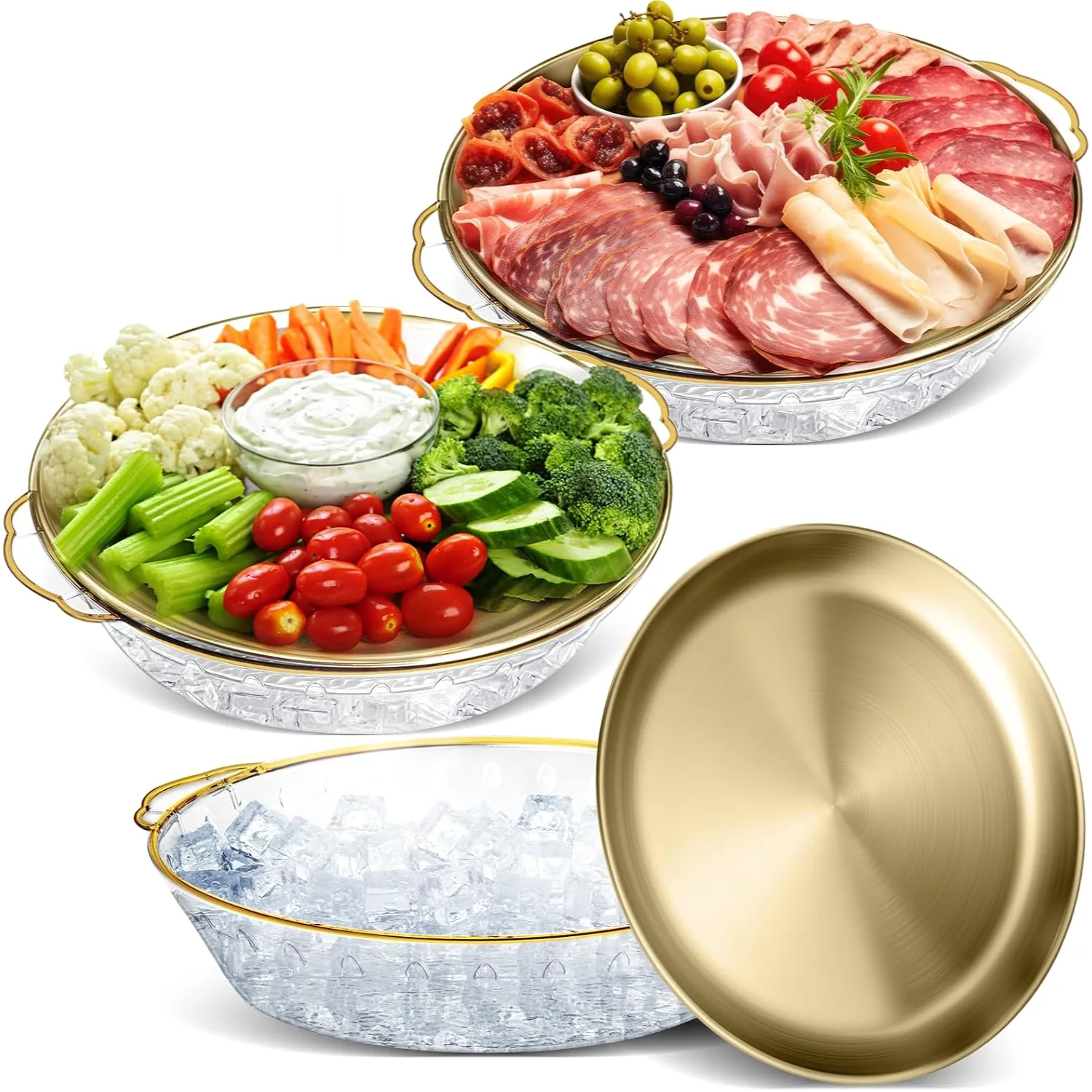
A purpose built chilled tray fixes both. The base is a shallow reservoir with a large flat top surface, and the compartment insert sits directly on it, so the cold face touches the whole underside of every compartment rather than a ring. The reservoir is sealed, so meltwater stays in it and off the table. The food sits in a thin layer over a large cold plate, which is the geometry that actually works.
Setting one up, in the order that matters
- Chill the base first. Either fill the reservoir with ice an hour before guests arrive, or freeze the base overnight if it is the freezable kind. A base filled with ice five minutes before serving is a base that spends the first half hour catching up.
- Chill the food separately. A tray cannot cool food down, it can only hold food cold. Anything going on it should come straight from the fridge, not from a chopping board that has been out since lunch.
- Fill the compartments no more than about two thirds deep. Depth is the enemy: the top of a heaped compartment is far from the cold surface, and it warms first.
- Put the lid on until the first guest arrives, and back on during lulls. A lid holds several degrees and keeps insects off, which is the other half of an outdoor table.
- Keep the refill in the fridge, not on the table. Bring out a second full tray and take the first one in rather than topping up a warm one.
What actually needs to be cold, and what does not
Not everything on a party table is perishable, and treating everything as if it were wastes the cold surface you have. Roughly, the rule is that anything animal, anything cut, and anything creamy needs the cold; dry, cured, pickled and whole things do not.
| Food | Needs the chilled tray | Why |
|---|---|---|
| Cut fruit and melon | Yes | Cutting exposes the flesh; sugar and moisture together are ideal for bacteria |
| Dips with dairy or egg | Yes | Sour cream, yoghurt and mayonnaise bases are the classic two hour foods |
| Cooked shrimp and seafood | Yes | Perishable and quick to show it |
| Soft cheese, fresh mozzarella | Yes | High moisture cheeses sit firmly in the perishable category |
| Deli meats and pate | Yes | Ready to eat and not going to be cooked afterwards |
| Hard cheese, aged cheddar or parmesan | Not strictly | Low moisture and salty; tastes better a little warm anyway |
| Cured salami, prosciutto | Not strictly | Cured and dried; safe at room temperature for a few hours |
| Crackers, breadsticks, nuts | No | Cold makes crackers go soft; keep them dry and away from the tray |
| Olives, pickles, chutney | No | Acid and salt do the preserving |
| Whole uncut fruit | No | The skin is the protection |
Laying out a table people can actually reach
Once the cold problem is solved, the remaining problem is traffic. A table where everyone has to reach across the dip is a table where the dip ends up on somebody's sleeve.
Three arrangements cover almost every party. For a table against a wall, put the tallest things at the back and the chilled tray at the front edge, because it is the thing people return to most. For a free standing table people can walk around, mirror the layout on both sides so there are two of everything and no queue. For a long table, break the spread into two identical stations rather than one long line, which halves the walking and stops a single bottleneck forming at the popular end.
Plates go at the start of the flow, napkins and cutlery at the end. It sounds trivial and it is the single most common layout mistake: guests holding cutlery cannot easily serve themselves.
What size tray for how many people
Tray sizing is the question we are asked most, and the honest answer is that it depends less on the number of guests than on how long the table stands and how many different things are on it. A tray with five compartments and twenty guests will be refilled twice; the same tray with eight guests will not be refilled at all.
The useful way to think about it is compartments per hour rather than guests per tray. Each compartment holds roughly one refill worth of a single item. For a two hour gathering with a dozen guests, five compartments is about right. Beyond that, a second tray beats a bigger one, because two trays let you keep one in the fridge while the other is on the table.
| Guests | Tray | Refills to plan for |
|---|---|---|
| 4 to 8 | One 9 inch round, three or four compartments | None for a two hour table |
| 10 to 16 | One 16 by 9 inch with five compartments | One, halfway |
| 16 to 30 | Two trays, alternating | Swap rather than top up |
| 30 and up | Two stations of two trays each | Swap at each station; avoid one long queue |
Round trays suit a table people walk around; rectangles suit a table against a wall, because the long edge presents everything at once. If you are buying one shape, buy the rectangle: it stores flat and it fits a fridge shelf, which matters more than it sounds when the tray has to be chilled in advance.
Cleaning and storing, which decides how many parties a tray survives
Chilled trays fail in two ways, and both are avoidable. The first is a cracked reservoir, almost always from being put in a freezer full of water rather than filled with ice, or from being knocked while frozen. The second is a cloudy, scratched insert, which comes from abrasive scourers and from cutting on the tray.
The routine that avoids both is short. Empty the reservoir before it goes anywhere; a base carried full will slosh and stress the seams. Wash the compartments in warm water with a soft cloth rather than a scourer, and rinse the fat off before it sets rather than soaking afterwards. Check whether the piece you have is dishwasher safe rather than assuming: on our trays the compartments usually are and the base often is not, because a base is a sealed void and a dishwasher will drive water into it.
Store the pieces separated rather than nested wet. A stack of damp compartments in a cupboard is how a tray develops a smell that no amount of washing removes.
Outdoors, where the rules get shorter
Everything above applies with less margin outside. Above 90 degrees the safe window drops to one hour, direct sun on a tray will beat any amount of ice, and insects arrive within minutes of the first sweet thing appearing.
Three practical measures: put the table in shade rather than moving it into shade later, use lids or mesh covers between waves of guests, and plan on two smaller servings rather than one large one so that the second comes out of a cool box at the halfway point. A cooler with a hanger, or a freezable tray base kept in the cool box until it is needed, is the difference between a spread that lasts and one that is cleared away early.
Afterwards: what to keep and what to bin
The end of a party is where most avoidable food poisoning is decided, usually by somebody tidying at midnight who cannot remember when the platter went out. The safe default is simple: if perishable food has been out longer than two hours, it goes in the bin, not in the fridge. Chilling something that has already spent three hours in the danger zone does not undo the three hours.
What does help is getting the rest cold fast. Shallow containers, not one deep bowl, because a deep container cools from the outside in and the middle can stay warm for hours. Lids on once cool. And label the date, because leftovers from a party are exactly the food nobody can date three days later.
The trays, compartments and covers in this guide are on chilled serving trays, the containers for the leftovers are on kitchen storage, and the rest of Baderke covers the table they all sit on. If drinks are the next problem, Cups, Lids and Counts: Planning Drinks for an Event does the arithmetic for those.